
Embered Roses
$8000.00
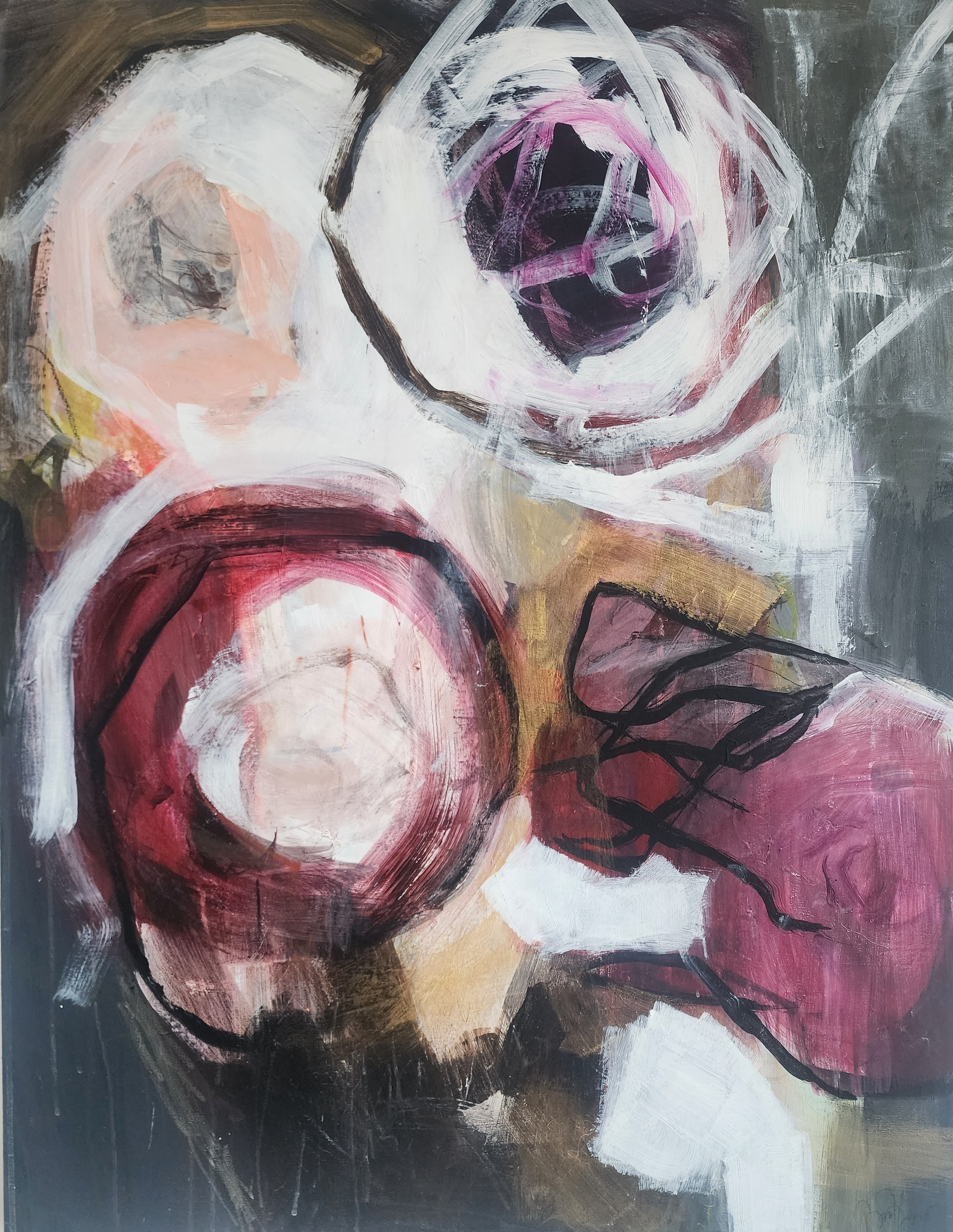
A constellation of circular forms dominates the field, each one built from layered sweeps of paint that alternately conceal and reveal the ground. Burgundy and deep rose anchor the lower half; above, a pale bloom of white and blush turns toward a darker, violet-centered spiral. These orbs feel both floral and celestial—part peony, part planet—so that the composition toggles between still life and cosmos. The surrounding space is rubbed and abraded charcoal-grey, scored with scratches and drags that keep the eye moving and prevent the painting from settling into symmetry.
The surface records a vigorous process. Broad, opaque bands of white carve into earlier layers, while transparent glazes of wine-red and plum stain the canvas beneath. Dry-brush passages scumble across the darker ground, catching the tooth of the support; elsewhere, paint is pushed wet-into-wet, leaving soft halos at the edges of the forms. Near the right center, a tangle of black linear marks—almost calligraphic—cuts across a mauve disc, introducing a bristling counterpoint to the otherwise rounded rhythm.
Compositionally, the circles are not identical; they carry different weights and temperatures, creating a conversation rather than a pattern. The largest, in the lower left, opens around a light core that reads like breath or reflected light; its counterpart at the top right compresses inward, dense with violets and crossed bands, as if holding something in reserve. Between them, wedges of ochre and umber act like earth or table, grounding the hovering forms. The off-centered cluster and diagonal sweep from upper left to lower right generate momentum, while the scratched verticals in the dark ground provide friction and pause.
The palette—blackened plum, garnet, blush, white, and pockets of ochre—carries a bodily warmth set against a cool, industrial grey. That tension shapes the mood: sensuous yet tough, blooming yet armored. The painting ultimately reads as a study in endurance—how soft, organic structures push back against pressure. Stand close and it’s all abrasion, slips, and edits; step back and the forms cohere into a bruised bouquet or a set of rising moons, luminous against weathered night.